
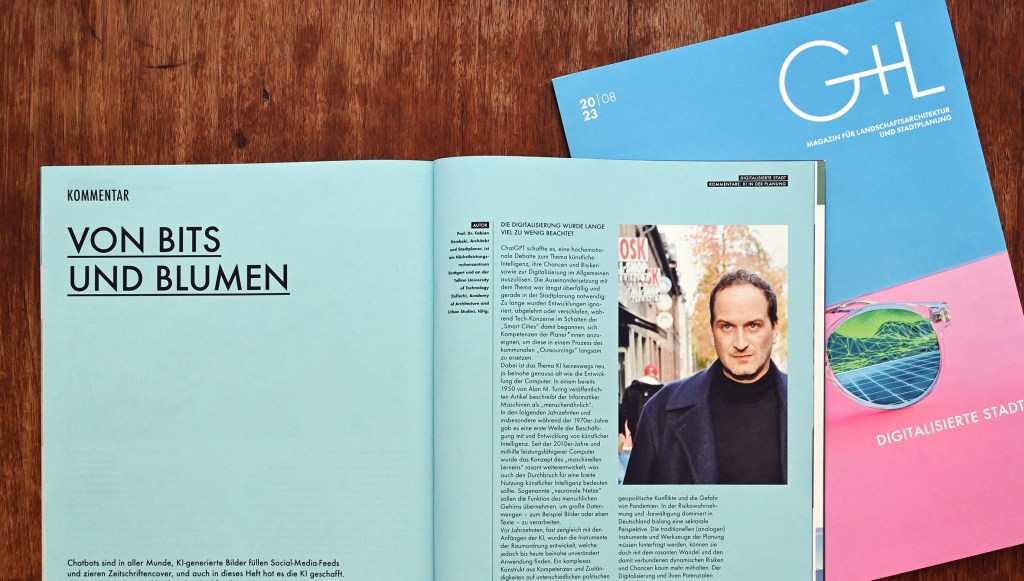
ChatGPT triggered a highly emotional debate on the topic of artificial intelligence, its opportunities and risks and digitalisation in general. Addressing the topic was long overdue and particularly necessary in urban planning: For too long, developments were ignored, rejected or slept through, while tech companies began to acquire planners’ skills in the shadow of “smart cities” in order to slowly replace them in a process of municipal “outsourcing”.
The topic of AI is by no means new, in fact it is almost as old as the development of computers. In an article published by Alan M. Turing in 1950, the computer scientist described machines as “human-like”. In the following decades, and particularly during the 1970s, there was a first wave of interest in and development of artificial intelligence. So-called “neural networks” are supposed to take over the function of the human brain in order to process large amounts of data – for example images or text.
Decades ago, almost at the same time as the beginnings of AI, spatial planning instruments were developed, which are still used almost unaltered until today. A complex construct of competences and responsibilities at different political levels clashes with a lack of human, financial, technical and infrastructural resources, especially in small and medium-sized towns. Land use plans in Germany, for example, which are the responsibility of the municipal level, are valid for ten to 15 years and are generally only updated at these intervals. This contrasts with ever shorter innovation cycles, complex global challenges such as the effects of anthropogenic climate change, geopolitical conflicts and the threat of pandemics. Risk perception and management in Germany has so far been dominated by a sectoral perspective. Traditional (analogue) planning instruments and tools need to be questioned, as they can hardly keep up with the rapid pace of change and the associated dynamic risks and opportunities. For a long time, far too little attention was paid to digitalisation and its potential. Digital tools such as data analytics, simulation and AI can support solutions to these highly complex challenges.
However, we should use them carefully and be aware that they can only be tools and not solutions per se. The current AI debate certainly offers the potential to tackle the challenges of digitalisation in planning and not leave them solely to the tech companies.
This article first appeared in German as an invited commentary in the G+L journal on the topic of artificial intelligence in landscape and spatial planning.
Further publications related to the topic:
Deckert, A.; Dembski, F.; Ulmer, F.; Ruddat, M.; Wössner, U. (2020). Digital tools in stakeholder participation for the German Energy Transition. Can digital tools improve participation and its outcome? In: Renn, O.; Ulmer, F.; Deckert, A. (Ed.). The Role of Public Participation in Energy Transitions. (161−177). Academic Press. DOI: 10.1016/B978-0-12-819515-4.00009-X.
Dembski, F. (2020): “Energy Conscious Urban Inward Development. Analytical Design Strategies for the Post-Oil City. The Case Study of Greater Paris“; TU Wien, 2020.
Dembski, F.; Wössner, U.; Letzgus, M.; Ruddat, M.; Yamu, C. (2020). Urban Digital Twins for Smart Cities and Citizens: The Case Study of Herrenberg, Germany. Sustainability, 12 (6), #2307. DOI: 10.3390%2Fsu12062307.
 Fabian Dembski